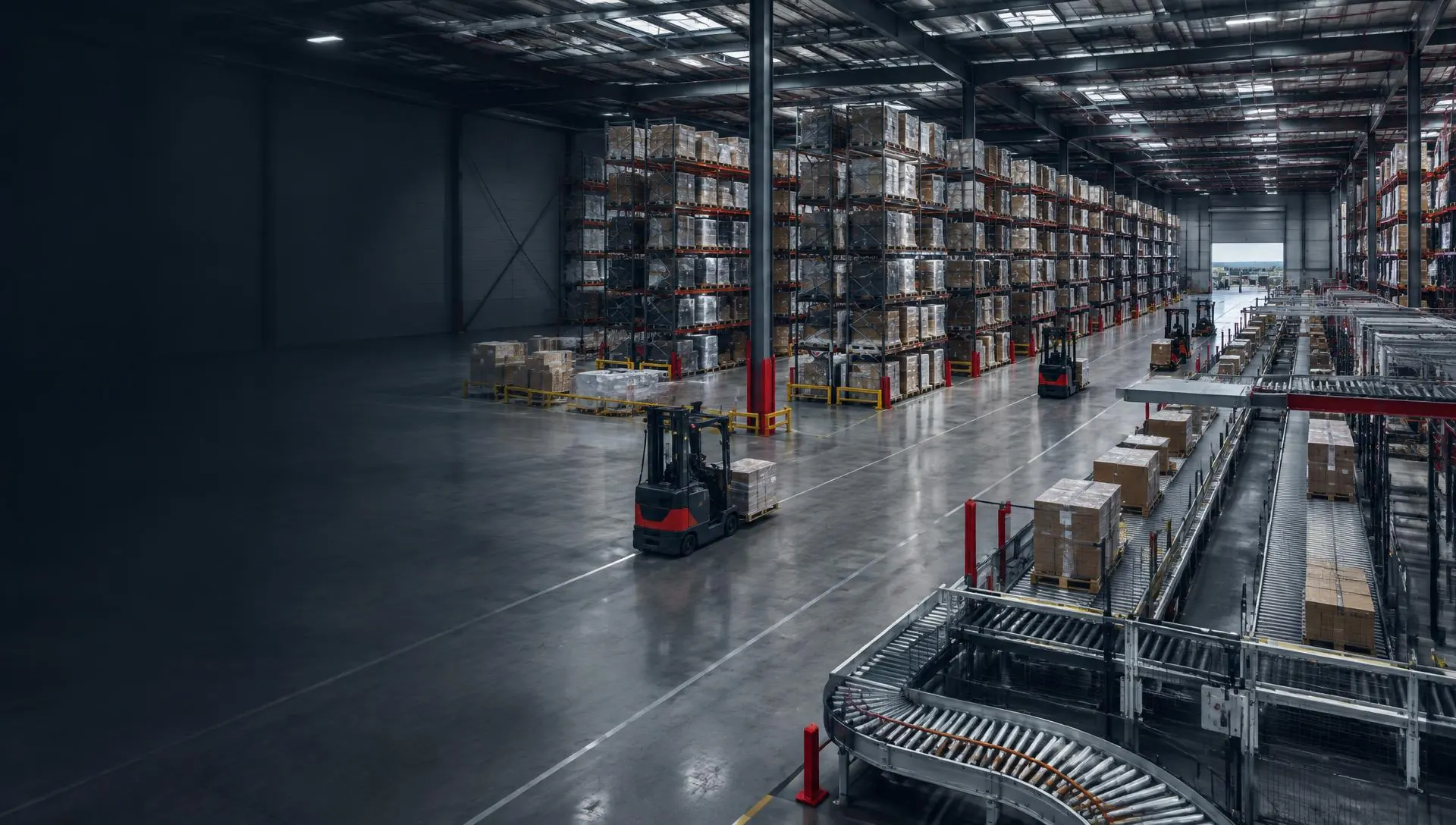
Automated distribution centre with pallet racking, forklifts and conveyor lines

Products

Ten products. Six solution areas. One platform.

Match your biggest pressure point to a starting product, and grow outward from there. Most projects start with one of four systems: TLS, WMS, AMR or ILS.

Portfolio map

Find your starting point

Warehouse & Inventory

Order Picking

Material Flow & Transport

Robotisation & Automation

Site Management & Access

Overview, Measurement & Efficiency

Products appear in more than one area. Most customers use more than one.

Where most projects start

One material flow, four control points

TLS

Transport Logistics System

Dock and yard management.

When trucks wait, you lose money. We manage every minute from gate to dock.

What it does

  • Carriers reserve time slots in advance, so peak loads spread out automatically
  • Self-service multilingual check-in by licence plate, QR code or mobile, with no gatehouse staff
  • Real-time yard navigation and visibility: every trailer's location at every moment
  • The warehouse sees planned and current shipments, so it acts ahead instead of reacting
  • Traffic-light dock control, camera evidence and a paperless audit trail
  • Integrates with WMS, ERP and carrier portals

Pairs well with

WMS for inbound and outbound flow. Veasy for visitor management at the same site. AMR for autonomous yard moves.

45%

Less loading and unloading time

20%

Lower transport cost

13

In-app languages

Typical deployment

8 to 16 weeks

Ideal for

Distribution and 3PLManufacturingRetailFMCGAutomotive
Discuss this system

WMS

Warehouse Management System

Active warehouse control, not just a digital logbook.

What it does

  • Real-time directed movements: the system tells operators where to go and what to do
  • OCR reading of batch and expiry from packaging, with no manual typing and no transcription errors
  • Continuous inventory accuracy without stopping operations for cycle counts
  • Full GS1 barcode support: one scan captures product, batch, expiry and quantity
  • Mobile app, AR overview and AI-driven material detection for advanced sites
  • Native integrations with ERP, AMR, TLS and existing scanner hardware

Pairs well with

M2L for faster picking. TLS for inbound and outbound flow. AMR for autonomous transport. Vision for inventory audit.

35%

Faster picking

30%

Higher efficiency

20%

Lower inventory

Typical deployment

8 to 16 weeks

Ideal for

Warehousing and 3PLManufacturingRetail and distributionHealthcare
Discuss this system

AMR

Autonomous Mobile Robots

24/7 material transport without the night shift. The difference is in the fleet software.

What it does

  • Proprietary fleet management software coordinates all robots automatically
  • Automatic task prioritisation based on real-time operational demand
  • Native integration with WMS, TLS and ERP, not a parallel robot system
  • Mixed-fleet support: manage robots from several manufacturers from one platform
  • Start with one or two robots and scale to 100+ without reconfiguration
  • Add-on modules: robotic arm, pallet lift, rack stacker

Pairs well with

WMS as the work source. Vision for obstacle detection at scale. TLS for yard moves.

24/7

Operation without a night shift

40%

Manual transfers eliminated

30%

Operator productivity gain

Typical deployment

16 to 36 weeks

Ideal for

Warehousing and 3PLManufacturing and productionDistribution centresHealthcare
Discuss this system

ILS

Internal Logistics System

The internal transport orchestrator: logistics movements between buildings, lines and zones.

What it does

  • Optimises logistics routes within and outside the company
  • Scheduled delivery and collection within configurable time slots
  • Efficient use of operators and vehicles: trolleys, tugs, forklifts
  • Hands-free working: operators get instructions without paper
  • Real-time status of every logistics task across the site
  • Performance overview by logistician, route and zone

Pairs well with

WMS for inventory linkage. eKANBAN for production-line replenishment. AMR for autonomous execution of routes.

30%

Higher work efficiency

90%

Fewer task errors

0

Paper-based tasks

Typical deployment

8 to 16 weeks

Ideal for

ManufacturingHealthcareLarge multi-building sitesDistribution
Discuss this system

Typical figures across deployments. We size the expected impact for your operation during the assessment.

The rest of the platform

Six more products that plug into the same data

M2L

Manipulate to Light

Light-guided picking: accuracy and speed for high-volume order flow.

  • LED guidance shows the quantity to pick from each position
  • Pick-by-light, put-by-light, kitting and sorting
  • 99.9% pick accuracy and twice the throughput of paper, from deployments at Jaguar Land Rover and DHL Exel

Typical deployment: 4 to 10 weeks

Vision

Visual Object Detection

Cameras and AI doing what cameras and people alone cannot.

  • Detection and inspection of objects, parts and packaging
  • Pick verification and visual inventory
  • Area safety: restricted zones and PPE compliance

Typical deployment: 6 to 14 weeks

OEE

Overall Equipment Effectiveness

See the losses you did not know you had.

  • Real-time monitoring of production-line loss factors
  • Downtime and maintenance reporting by cause
  • Drill-down by line, machine, shift and operator

Typical deployment: 8 to 16 weeks

eKANBAN

Electronic Kanban

Kanban without the paper and without the lost cards.

  • Digital cards and scanners replace physical Kanban cards
  • Orders material, flags shortages and triggers replenishment through SAP automatically
  • Live inventory on screens, tablets and mobiles

Typical deployment: 6 to 12 weeks

ORS

Operators Resource System

Who can do what, and where they are right now.

  • Qualification matrix: the skills required for each position
  • Fast team reassembly when operators are unexpectedly absent
  • Surfaces quality losses and cost drivers tied to skill gaps

Typical deployment: 6 to 12 weeks

Veasy

Visitor Management System

A modern front door for industrial sites.

  • Visitors pre-register on a mobile app before they arrive
  • Contactless entry by QR code, with no badges to print or lose
  • Access limited to assigned zones, with an audit log of every movement

Typical deployment: 4 to 8 weeks

Product bundles

Solutions that grow together

Five proven combinations. Start with one problem and expand as the results land.

Smart Warehouse

WMS + M2L

Real-time control plus light-guided picking. The classic warehouse upgrade: accuracy, speed and visibility from day one.

End-to-End Material Flow

WMS + TLS + ILS

From dock to shelf to line. Removes the gaps where material waits, errors creep in and visibility breaks.

Production Excellence

OEE + ORS + eKANBAN

See losses, manage operators, replenish without paper. The bundle for manufacturing leaders.

Autonomous Operations

WMS + AMR + Vision

Software-directed work, robots that move it, vision that watches. Built for sites scaling past human-only operations.

Site and Visitor Control

TLS + Veasy

Trucks managed from the gate, visitors managed at reception. Same logic, same vendor, fully integrated.

Integration

Built to fit your existing stack

You do not want to rip and replace. We will not ask you to.

SAP / ERP
MES
WMS / TMS

M2M Platform

Connector layer

CRM / Portals
Scanners / IoT
3PL / EDI

What you can count on

  • Native SAP integration: reliable data exchange in both directions
  • REST and SOAP APIs, EDI, webhooks and file drops: whatever you run
  • Error handling and reconciliation built in, with no silent failures
  • Encrypted transport, authentication and digital signatures
  • Compatible with existing WMS, TMS, MES, ERP and 3PL portals
  • Phased integration: start narrow and expand without re-platforming

How we deliver

One delivery model, four stages

Every engagement moves through the same four stages, scaled to the size of the site and the process being changed.

01

Operations assessment

We walk the site, map the current flow of goods and data, and quantify where time and accuracy are lost. The output is a written picture of the process, a prioritised gap list and a scoped first phase, usable even if you go no further with us.

  • Process and data-flow mapping
  • Bottleneck and error analysis
  • Scoped phase-one proposal
02

Integration & architecture

Logistics software only pays off when it agrees with the rest of your landscape. We design the interfaces to ERP, MES, carrier portals and automation hardware, and define the data contracts before code is written.

  • ERP and MES interface design
  • Device, scanner and PLC connectivity
  • Master-data and cutover planning
03

Phased implementation

Delivery runs in defined phases against a live operation. Configuration, integration testing, operator training and go-live are carried out on site, so the team using the system has practised on it before the first shift depends on it.

  • Configuration and test cycles
  • Operator and supervisor training
  • On-site go-live and hypercare
04

Local support & optimisation

Support runs on Australian business hours with a defined escalation path into the group's product engineers. Beyond incident handling, we review performance against agreed measures and tune configuration as volumes and product mix change.

  • AEST support with agreed response targets
  • Escalation to group engineering
  • Periodic performance review and tuning

Scoped in phases

Each phase has its own deliverable and acceptance point, so investment is committed step by step rather than up front.

Delivered on site

Assessment, testing and go-live happen in your facility with your team, not remotely against a specification document.

Backed by the group

Local delivery draws on the product engineering team behind systems in production across European industrial sites since 2010.

Not sure which system to start with? Most projects begin with a single process and extend once it is stable.

Arrange an assessment